Peer Reviewed Articles for Color Theory Primary Colors
Color theory encompasses a multitude of definitions, concepts and design applications - enough to make full several encyclopedias. However, there are iii basic categories of color theory that are logical and useful : The color wheel, color harmony, and the context of how colors are used.
Color theories create a logical structure for color. For example, if we take an array of fruits and vegetables, nosotros tin organize them by color and identify them on a circle that shows the colors in relation to each other.
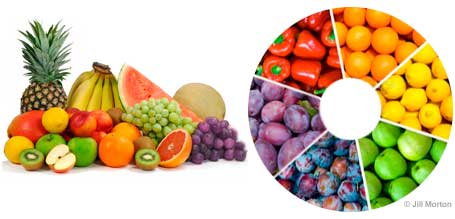
The Colour Cycle
A colour circle, based on ruby-red, yellowish and bluish, is traditional in the field of fine art. Sir Isaac Newton developed the first circular diagram of colors in 1666. Since then, scientists and artists have studied and designed numerous variations of this concept. Differences of opinion about the validity of one format over some other continue to provoke debate. In reality, any color circle or color wheel which presents a logically bundled sequence of pure hues has merit.
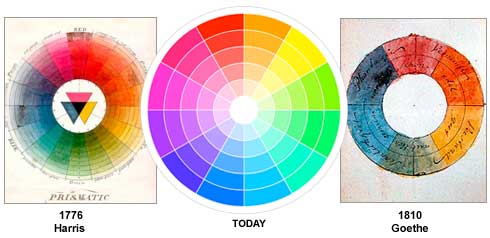
In that location are also definitions (or categories) of colors based on the color wheel. We begin with a three-part colour wheel.
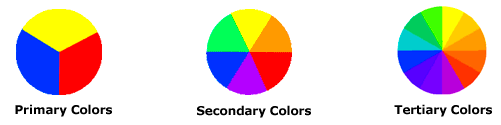
Chief Colors: Scarlet, yellow and blue
In traditional color theory (used in paint and pigments), primary colors are the 3 paint colors that cannot be mixed or formed by whatever combination of other colors. All other colors are derived from these iii hues.
Secondary Colors: Dark-green, orangish and purple
These are the colors formed by mixing the main colors.
Third Colors: Yellow-orange, scarlet-orange, red-majestic, blue-imperial, blue-green & yellow-green
These are the colors formed past mixing a primary and a secondary colour. That's why the hue is a two word name, such every bit blueish-green, ruby-red-violet, and yellow-orange.
Color Harmony
Harmony tin can be defined as a pleasing arrangement of parts, whether it be music, poesy, color, or even an water ice cream sundae.
In visual experiences, harmony is something that is pleasing to the eye. It engages the viewer and it creates an inner sense of order, a rest in the visual experience. When something is non harmonious, it's either boring or chaotic. At one extreme is a visual experience that is so banal that the viewer is not engaged. The human being brain volition reject under-stimulating information. At the other farthermost is a visual feel that is then overdone, and so cluttered that the viewer tin can't stand up to expect at it. The man brain rejects what information technology cannot organize, what it cannot understand. The visual chore requires that we present a logical structure. Color harmony delivers visual interest and a sense of order.
In summary, extreme unity leads to under-stimulation, extreme complexity leads to over-stimulation. Harmony is a dynamic equilibrium.
Some Formulas for Colour Harmony
There are many theories for harmony. The following illustrations and descriptions nowadays some bones formulas.
1. A color scheme based on analogous colors
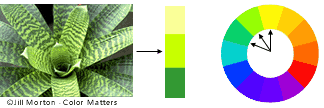
Analogous colors are any three colors which are side by side on a 12-role color wheel, such as yellow-dark-green, yellow, and yellow-orangish. Commonly one of the three colors predominates.
two. A color scheme based on complementary colors
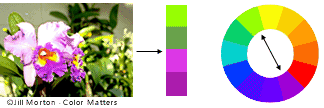
Complementary colors are whatsoever ii colors which are straight opposite each other, such every bit red and dark-green and cherry-purple and yellowish-dark-green. In the illustration above, there are several variations of yellow-light-green in the leaves and several variations of crimson-majestic in the orchid. These opposing colors create maximum contrast and maximum stability.
3. A colour scheme based on nature

Nature provides a perfect difference betoken for color harmony. In the illustration above, scarlet yellow and green create a harmonious design, regardless of whether this combination fits into a technical formula for color harmony.

Dynamic recipes for color harmony
An e-Course from Jill Morton, Color Matters author & consultant.
Colour Context
How color behaves in relation to other colors and shapes is a complex expanse of color theory. Compare the contrast furnishings of different color backgrounds for the same blood-red square.
Cherry appears more bright against a black background and somewhat duller against the white background. In contrast with orange, the red appears lifeless; in contrast with blueish-light-green, it exhibits brilliance. Notice that the red square appears larger on black than on other background colors.
Different readings of the same color
If your figurer has sufficient color stability and gamma correction (link to Is Your Computer Color Blind?) you volition see that the small majestic rectangle on the left appears to have a red-purple tinge when compared to the small regal rectangle on the correct. They are both the same color as seen in the illustration below. This demonstrates how three colors tin exist perceived as four colors.

Observing the effects colors have on each other is the starting point for agreement the relativity of color. The relationship of values, saturations and the warmth or coolness of corresponding hues tin cause noticeable differences in our perception of color.

Acquire the language of color online
DIY - Learn at your own pace.
Source: https://www.colormatters.com/color-and-design/basic-color-theory
0 Response to "Peer Reviewed Articles for Color Theory Primary Colors"
Publicar un comentario