After Putting in an Exponent of the Ti 84 How Do I Get It Normal Again
Using [–] instead of [(-)] to indicate that a number is negative.
If you lot press [–] instead of [(-)] at the beginning of an entry, the estimator assumes you want to subtract what comes subsequently the minus sign from the previous answer. If you use [–] instead of [(-)] in the interior of an expression to denote a negative number, the calculator responds with the Mistake: SYNTAX error message.
Indicating the order of operations incorrectly past using parentheses
When evaluating expressions, the order of operations is crucial. To the calculator, for example, –32 equals –9. This may come as quite a surprise to someone expecting to square –3, where (–3)ii equals 9. The calculator get-go performs the operation in parentheses, then information technology squares the number, and if there is a negative exterior the parentheses, it first performs the squaring and so the functioning of negating a number.
Unless y'all're careful, this won't provide the answer you're looking for. To guard against this error, yous may want to review the detailed list of the lodge in which the calculator performs operations.
Improperly entering the argument for carte functions
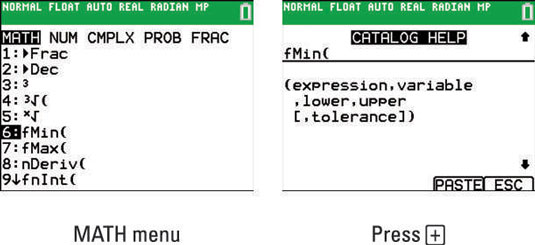
If an argument is improperly entered, a menu role won't work. A prime example is the fMin function housed in the Math MATH carte. Practice you lot remember what to place afterward this function and so that you can utilize it? If y'all don't, you get the ERROR: ARGUMENT fault message.
To avoid this error, you tin use the Catalog Help feature to see the syntax of the office you would like to apply. Printing [MATH] and use the down-pointer key to move your cursor to the fMin function as shown in the first screen. Press [+] to access the Catalog Help feature as illustrated in the 2nd screen.
Accidentally deleting a listing
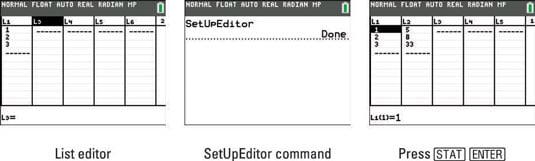
If your cursor is in the column heading and you press [DEL], the list disappears from view. List L2 isn't displayed in the offset screen. Don't worry! You can recover the list by using the SetUpEditor control. Printing [STAT][5][ENTER], as shown in the second screen. List L2 is now restored in the List editor. Press [STAT][ENTER] to run across the lists, as shown in the third screen.
Entering an angle in degrees in Radian mode
To change the mode, printing [Way], motility your cursor to DEGREE and printing [ENTER].
Alternatively, you can enter an bending in degrees when you lot are in Radian fashion, just y'all have to let the calculator know that you're overriding the Angle way by placing a degree symbol later your entry. To insert a degree symbol, printing [2nd][APPS][ENTER].
Graphing trigonometric functions in Degree style
This, also, is a fault unless you lot do it just right: In the Window editor, you have to prepare the limits for the x-axis every bit –360 is less than or equal to x, which is less than or equal to 360.
Pressing [ZOOM][vii] or [ZOOM][0] to have the calculator graph the function using the ZTrig or ZoomFit command produces similar results. But this works when you're graphing pure trig functions such as y = sin x. If you're graphing something like y = sin 10 + 10, life is a lot easier if you lot graph it in Radian mode.
Graphing functions when stat plots are agile
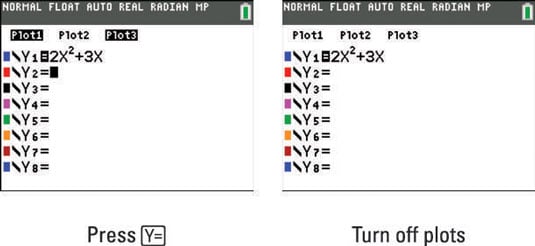
If you lot get the ERROR: DIMENSION MISMATCH error bulletin when you graph a function, this is most likely caused by a stat plot that the calculator is trying to graph forth with your office. You lot can turn off the stat plot on the Y= editor screen.
Press [Y=], and run across if any of the stat plots are highlighted at the top of the Y= editor screen. Stat Plot1 and Stat Plot3 are highlighted in the first screen. Move your cursor over the highlighted stat plots and press [ENTER] to turn off the stat plots, as illustrated in the second screen.
Inadequately setting the display contrast
If your screen is also calorie-free or too nighttime to read the calculations, yous tin prepare information technology easily. To adjust the dissimilarity settings to your liking, repeatedly press [2nd] and the upwards-arrow cardinal to darken the screen or press [second] and the down-arrow key to lighten the screen.
Setting the window inappropriately for graphing
If yous get the ERROR: WINDOW RANGE fault message when graphing functions, this is most likely caused past setting Xmin greater than or equal to Xmax or past setting Ymin greater than or equal to Ymax in the Window editor.
Accidentally deactivating a function
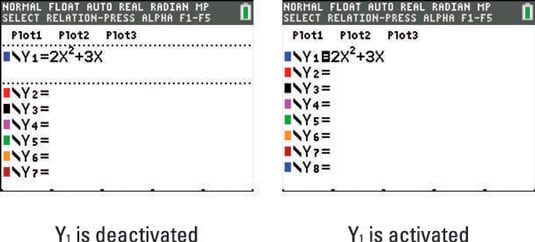
This tin exist ane of the near frustrating mistakes yous can make. You have to be paying attention to observe that a function has been deactivated. See the start screen. Notice the equal sign adjacent to Yane isn't highlighted. This means the function has been deactivated.
To actuate a office that has been deactivated, move your cursor to the equal sign in the Y= editor and printing [ENTER].
About This Article
This article tin can exist found in the category:
- Graphing Calculators ,
Source: https://www.dummies.com/article/technology/electronics/graphing-calculators/10-common-errors-when-using-the-ti-84-plus-204103/
0 Response to "After Putting in an Exponent of the Ti 84 How Do I Get It Normal Again"
Publicar un comentario